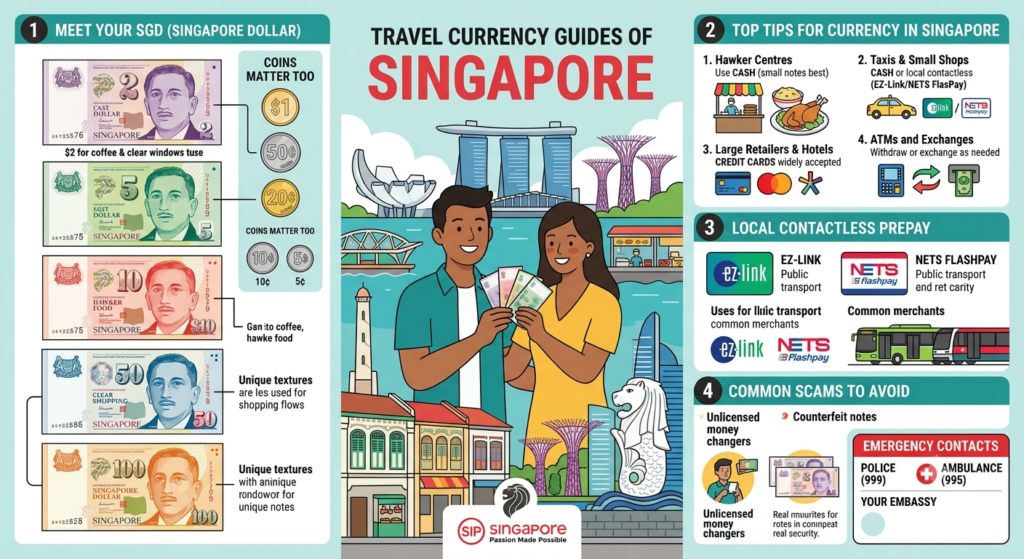
Singapore has one of Asia’s most modern and efficient payment ecosystems, making it easy for residents, business travellers, and tourists to manage everyday spending. Whether you’re visiting for a few days or planning a longer stay, understanding the Currency Guides of Singapore can help you avoid unnecessary fees, use trusted exchange services, and pay confidently across the country.
This guide explains the official Singapore Dollar (SGD), where to exchange money safely, how cashless payments work, ATM availability, tipping customs, and important regulations. All information is based on standard practices and official guidance from the Monetary Authority of Singapore (MAS) and other authorised institutions. Exchange rates and financial regulations may change over time, so it is always advisable to check official sources before travelling.
What Is the Official Currency of Singapore?
Short answer: The official currency of Singapore is the Singapore Dollar (SGD), commonly written as S$ or SGD.
The Singapore Dollar is issued and managed by the Monetary Authority of Singapore (MAS), Singapore’s central bank and financial regulator. The currency is recognised for its strong security features, high international credibility, and stable monetary framework.
Although Singapore welcomes visitors from around the world, foreign currencies are generally not accepted as legal tender for everyday transactions. Most shops, restaurants, attractions, and transport providers expect payment in Singapore Dollars or through accepted electronic payment methods.
The Singapore Dollar is also interchangeable at par with the Brunei Dollar under a long-standing Currency Interchangeability Agreement, although availability of Brunei notes varies by retailer and bank.
Official SGD Denominations
Short answer: Singapore uses a range of banknotes and coins designed for everyday transactions.
Singapore Dollar Notes
The official banknote denominations are:
- S$2
- S$5
- S$10
- S$50
- S$100
- S$1,000
- S$10,000
While S$1,000 and S$10,000 notes remain legal tender, they are no longer issued as part of measures to reduce money laundering risks. Most daily transactions use S$2 to S$100 notes.
Singapore Coins
Current coin denominations include:
- 5 cents
- 10 cents
- 20 cents
- 50 cents
- S$1
- S$5
The S$5 coin is issued primarily as a commemorative or collector coin and is rarely encountered in everyday circulation.
Security Features of Singapore Banknotes
Singapore banknotes include multiple security features to help prevent counterfeiting. Depending on the series, these may include:
- Security threads
- Watermarks
- Colour-shifting ink
- Transparent windows (on polymer notes)
- Microprinting
- Raised printing
- Complex background patterns
If you receive a damaged or suspicious note, banks can advise on replacement procedures or authenticity checks.
Where Can I Exchange Money Safely in Singapore?
Short answer: Use authorised banks or licensed money changers.
Singapore is well known for its competitive foreign exchange market, with many licensed money changers offering transparent rates.
Popular exchange locations include:
- The Arcade (Raffles Place)
- Chinatown
- Orchard Road
- Major shopping malls
- Changi Airport
- Commercial districts
These areas often have multiple licensed money changers, allowing customers to compare exchange rates before making a transaction.
Banks
Major Singapore banks also provide foreign exchange services, including:
- DBS
- OCBC
- UOB
- Standard Chartered
- HSBC
- Citibank
Banks may charge different exchange spreads compared with specialist money changers but provide secure and regulated services.
Changi Airport
Currency exchange counters are available throughout Singapore Changi Airport.
Airport counters provide convenience for arriving travellers, although exchange rates may differ from those available in the city centre.
Avoid Unauthorised Currency Exchange
For your safety:
- Use licensed money changers
- Exchange money at authorised financial institutions
- Request receipts
- Count your money before leaving the counter
- Compare displayed exchange rates
Avoid exchanging money through informal individuals or unregulated street exchanges, as these may expose you to fraud or counterfeit currency.
Payment Methods in Singapore
Short answer: Singapore is largely cashless, although carrying a small amount of cash is still useful.
Credit and Debit Cards
Cards are widely accepted at:
- Hotels
- Restaurants
- Shopping centres
- Tourist attractions
- Supermarkets
- Department stores
- Convenience stores
Visa, Mastercard, American Express, and UnionPay are commonly accepted.
Some merchants may set a minimum purchase amount for card payments.
Mobile Payments
Singapore has embraced digital payments across many sectors.
Popular payment methods include:
- Apple Pay
- Google Pay
- Samsung Wallet
- PayNow
- NETS
- Selected QR payment systems
Many retail stores, cafés, and supermarkets support contactless payments.
Cash
Although cashless payments are widespread, cash remains useful for:
- Some hawker centres
- Traditional markets
- Small neighbourhood shops
- Certain taxis
- Older independent businesses
Many hawker stalls increasingly accept digital payments, but availability varies.
Can I Use Foreign Currency Directly?
Short answer: Generally, no.
Singapore businesses usually require payment in Singapore Dollars or accepted electronic payment methods.
Hotels or selected tourist businesses may quote approximate foreign currency prices for convenience, but settlement is normally made in SGD or converted automatically through card networks.
ATMs and Cash Withdrawals
Short answer: ATMs are widely available throughout Singapore.
Visitors can easily find ATMs at:
- MRT stations
- Shopping malls
- Airports
- Banks
- Commercial buildings
- Tourist districts
Most international debit and credit cards work with ATMs displaying compatible network logos.
ATM Fees
Fees vary depending on:
- Your home bank
- Card issuer
- ATM operator
- International network
Before travelling, check with your bank regarding:
- Foreign withdrawal fees
- Currency conversion charges
- Daily withdrawal limits
Some banks reimburse overseas ATM fees, depending on account type.
Cash or Card: Which Is Better?
For most visitors, a combination works best.
Cards are ideal for:
- Hotels
- Shopping
- Attractions
- Dining
- Public transport (supported cards)
Cash is useful for:
- Hawker centres
- Small purchases
- Local markets
- Community events
- Emergency situations
Keeping a modest amount of cash while relying mainly on cards is a practical approach.
Tipping Etiquette
Short answer: Tipping is not mandatory in Singapore.
Unlike some countries, Singapore generally does not expect tips.
Many restaurants already include:
- Service charge (often 10%)
- Goods and Services Tax (GST)
Optional tipping may be appreciated in exceptional situations but is not part of normal local etiquette.
Bringing Money Into or Out of Singapore
Short answer: There are declaration requirements for large amounts of physical currency.
Travellers carrying physical currency or bearer negotiable instruments valued at S$20,000 or more (or the equivalent in foreign currency) into or out of Singapore must comply with declaration requirements under Singapore law.
These rules help combat money laundering and terrorism financing.
If you are travelling with large sums, consult the relevant government guidance before departure.
Practical Money-Saving Tips
Managing your money wisely can reduce unnecessary costs during your stay.
Helpful tips include:
- Compare exchange rates between licensed money changers.
- Avoid exchanging all your money at the airport if better rates are available elsewhere.
- Check whether your credit card charges foreign transaction fees.
- Use contactless payments where convenient.
- Keep small denominations for hawker centres and neighbourhood shops.
- Retain exchange receipts where appropriate.
- Notify your bank before international travel if required.
- Monitor exchange rates through reputable financial providers.
Frequently Asked Questions
What is the official currency of Singapore?
Singapore uses the Singapore Dollar (SGD), issued by the Monetary Authority of Singapore.
What denominations are available?
Common notes include:
- S$2
- S$5
- S$10
- S$50
- S$100
Coins include:
- 5¢
- 10¢
- 20¢
- 50¢
- S$1
- S$5 (limited circulation)
Where can I exchange money safely?
Choose:
- Licensed money changers
- Banks
- Changi Airport exchange counters
- Authorised financial institutions
Avoid informal or unlicensed exchange services.
Can I use US Dollars or other foreign currencies?
Generally no. Singapore businesses typically accept payments only in Singapore Dollars or approved electronic payment methods.
Are ATMs easy to find?
Yes. ATMs are available across Singapore in banks, shopping centres, MRT stations, airports, and commercial districts.
Should I carry cash?
Yes, although not a large amount. Cards are accepted almost everywhere, but some smaller merchants still prefer cash.
Do I need to tip?
No. Tipping is not expected in Singapore because many establishments already include a service charge.
Is Singapore a cashless society?
Singapore is highly cashless, with extensive acceptance of contactless cards, mobile wallets, and digital payment platforms. Cash remains useful for certain smaller businesses and markets.
Conclusion
Understanding the Currency Guides of Singapore helps visitors and residents make informed financial decisions while travelling or living in the country. The Singapore Dollar is a stable and widely trusted currency, and everyday payments are supported by an advanced banking system, extensive ATM network, and widespread acceptance of contactless payment methods.
For the best experience, exchange money only through MAS-regulated financial institutions or licensed money changers, compare exchange rates before converting funds, and remember that foreign currencies are generally not legal tender for routine transactions in Singapore. Finally, check official guidance from the Monetary Authority of Singapore and authorised financial institutions for the latest information on currency regulations, payment services, and declaration requirements before your trip.